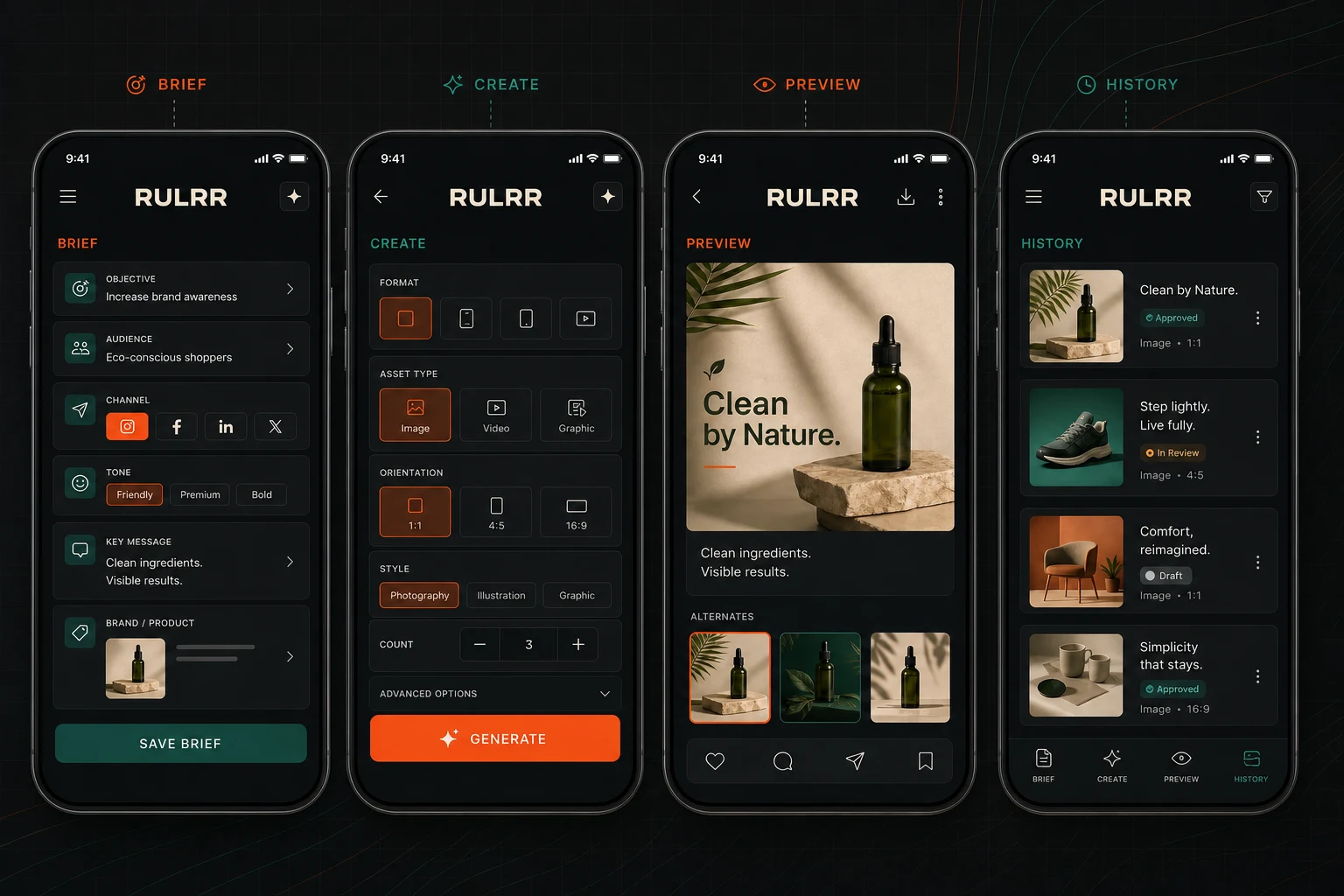
An AI-enabled product workflow carried across the user experience, backend coordination, persistence, and production delivery—described without disclosing Rulrr’s private system.
Conceptual content generation studioPortfolio visualization—not the actual Rulrr UI
Context
Generation needed to behave like a product capability.
The challenge was not simply calling an AI service. The workflow had to fit naturally into an existing product, carry user intent through the system, manage asynchronous states, and return useful output in a way the interface could explain.
Contribution
Ownership across both sides of the request.
As a Full-Stack Engineer, I worked across the product surface and the service layer: shaping the user-facing flow, coordinating backend generation work, handling state and persistence, and supporting the path from request to delivered result.
System thinking
A clear lifecycle for an uncertain operation.
Input handling and validation before generation begins
Explicit progress, success, retry, and failure behavior
Backend orchestration around the generation lifecycle
Persistence and retrieval of generated results
Product-safe error handling and operational visibility
Outcome
AI embedded into the workflow, not attached as a demo.
The system turned generation into a usable product capability with a defined lifecycle across frontend and backend. It gave users a clearer experience while giving the engineering team a more maintainable path for operating and evolving the feature.
Responsible disclosure
Public proof without exposing private implementation.
This page does not disclose actual prompts, model configuration, private endpoints, database structures, customer content, product screenshots, internal workflows, unreleased capabilities, or confidential performance figures. The showcase is an original conceptual visualization—not an actual Rulrr screen or architecture document.